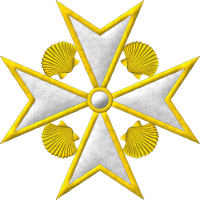
A chivalric order instituted in 1290 by Floris V, Count of Holland, and bonded today with the princely House of Bentheim, successors of the Counts of Holland.
The Most Noble Equestrian Order of Saint James in Holland was instituted in 1290 by Count Floris V of Holland, founded as an order of knighthood. The Order is first named in surviving records in a chronicle from the beginning of the fourteenth century, and appears thereafter in the historical literature of Holland and Zeeland across five centuries.
It is today a dynastic order, bonded with the House of Bentheim, which is regarded as the legal successor of the Counts of Holland. Its object is the preservation of the norms and values of chivalry, together with charitable work, the writing of its history, and the keeping of its archive.
The Order later received its present name — Order of Saint James — as recorded in the collection of Mr. A.C. baron Snouckaert van Schauburg (1803–1878) held by the Hoge Raad van Adel (inv. no. 147).
As the son of a Holy Roman Emperor (William II), Count Floris V of Holland naturally inherited a broad European perspective, which he further expanded by actively projecting his influence across the major courts of the thirteenth century. Recognizing that his county's prosperity relied heavily on the wool trade, the founder of the Order of Saint James forged strategic, albeit shifting, alliances with powerful monarchs like King Edward I of England and King Philip IV of France, while also marrying Beatrice of Dampierre to broker peace with his rivals in Flanders. His geopolitical ambitions extended well beyond the Low Countries; in 1292, he even crossed the North Sea to assert a dynastic claim to the Scottish throne during the succession crisis known as the Great Cause. Ultimately, this deep entanglement in European high politics sealed his fate, as his decision to shift his allegiance from England to France prompted an angered Edward I to conspire with disgruntled local nobles, resulting in the Count's assassination on 27 June 1296.
Membership of the Order is by invitation. The Order does not solicit applications.