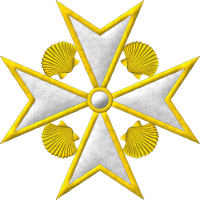
The Most Noble Equestrian Order of Saint James was instituted in 1290 by Floris V, Count of Holland. Its early history survives through the chronicles of Holland and Zeeland and the works of later antiquaries; the earliest surviving mention is a chronicle from the beginning of the fourteenth century.
The foundation, 1290
The Chronicle of Holland, written by the clerk of the low countries by the sea, records the foundation as follows.
Grave Florys, deze eedele vorste, als hy die Vlamingen wederstaen hadde, besette hy Zeelant, ende tooch in Hollant. Ende als hy daer een tyt vredelick geweest hadde, dochte hy over, hoe dat hy in zynre tyt alsoe veel gheoorloocht ende zoe merlgen bloedigen stryt gestreden ende gestormt hadde, ende oick in eenre sterfte zoe veel gestorven dat hy al te luttel ridderscaps in zynen lande hadde, des hy qualiken te vreeden was. Ende om zyn ridderscap te meeren zoe ontboet hy, op enen heiligen kersdach by hem te hove te comen veertich, die ryckste ende oirbaerste huysluyden, die hy in den lande van Hollant bevinden conde, ende die wel gegoet waren ridders staet te houden. Mit dese XL. goede mannen hylt hy hoegen hof, ende int eynde van den maeltyt zoe sloech hy se ridder, ende gaf hem wapen, ende beval hem voirtaen ridderscap te oeffenen, ende wel te doen ende varen elc hoers weeghes. … Aldus soe eerde dese eedele grave syn goede luden, die eerbaer en duegende waren van weldaden ende van rycheeden, ende en sach die coemst nyet an; maer hy meerde zyn ridderscap ende zyn eedel lude, daer hy hem zelven ende zun lant meede eerde; wanttet immer eerlick is, dat veel ridders in eenen lant syn. Hier om ende omdat hy zyn goede huysluden alsoe dueen te beroemen plach ende lief hadde, soe haddens die oude ridderscap sommigen groten nyt, ende plagen desen grave te noemen der keerlen God.
Chronyk van Holland, van den klerk uit de laage landen by der zee — early fourteenth century
The Order later received its present name, Order of Saint James, as recorded in the collection of Mr. A.C. baron Snouckaert van Schauburg (1803–1878), held by the Hoge Raad van Adel (inv. no. 147).
Development
After the Middle Ages, when many orders of knighthood fell into oblivion, the Order of Saint James continued quietly. Though power and prominence had passed, and other orders came to the fore, the Order is consistently recorded in the historical literature — by Boxhorn, Van Gouthoven, Schoonebeek, Butkens, De Rouck and Le Petit, among others.
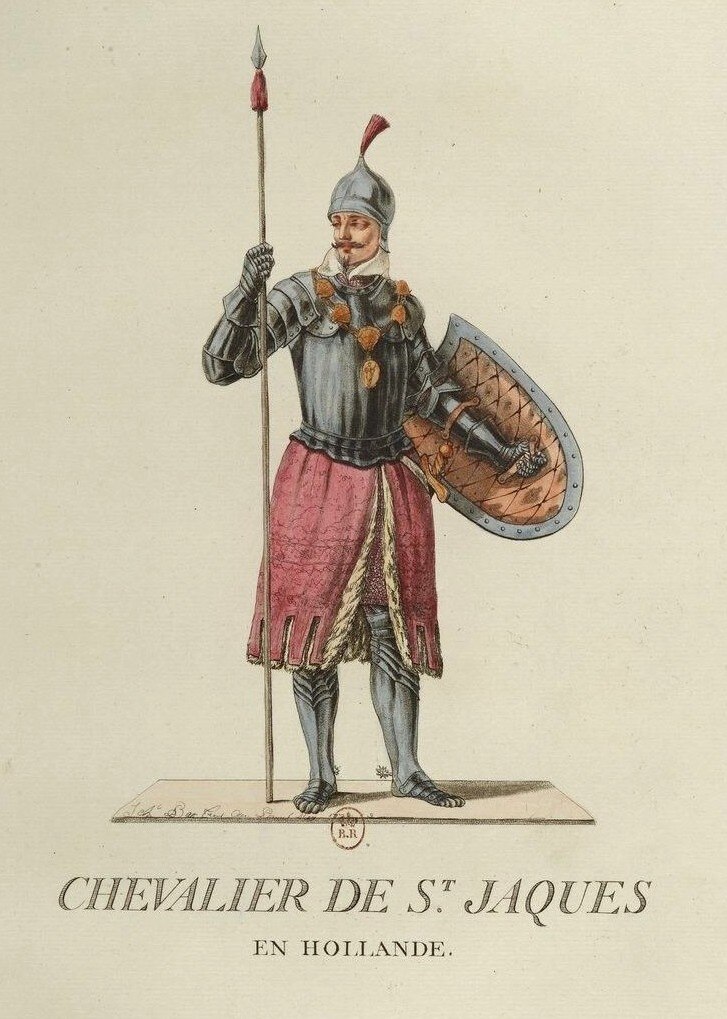
A notable change of this period is the introduction of the eight-pointed cross, worn upon the mantle. This reflects a broader development of the sixteenth century, in which many orders of knighthood exchanged the Latin cross for the Maltese cross. The image of Saint James was retained in a round medallion upon the chain.
The nineteenth century
In 1814 King William I considered reviving the Order of Saint James as a national order of knighthood. In the end he chose to name his new order the Order of the Netherlands Lion (J.A. van Zelm van Eldik, Moed en deugd. Ridderorden in Nederland, Zutphen, 2003, p. 164 ff.).
In 1845 the students of Leiden University devoted their masquerade, on the 270th anniversary of the university, to the procession of Count Floris V with the newly created Knights of Saint James to the tournament given at 's-Gravenhage upon the institution of the Order.
The modern era
In modern times the Order has continued within Catholic circles, where it has been passed on to new knights. A portion of its documentation has been lost, particularly during the Second World War; fragments of the membership lists survive.
With a growing membership, the Order devotes itself at present to charitable work, while the writing of its history and the care of its historical archive remain central. The Order of Saint James is an historic institution in the history of the Netherlands.